
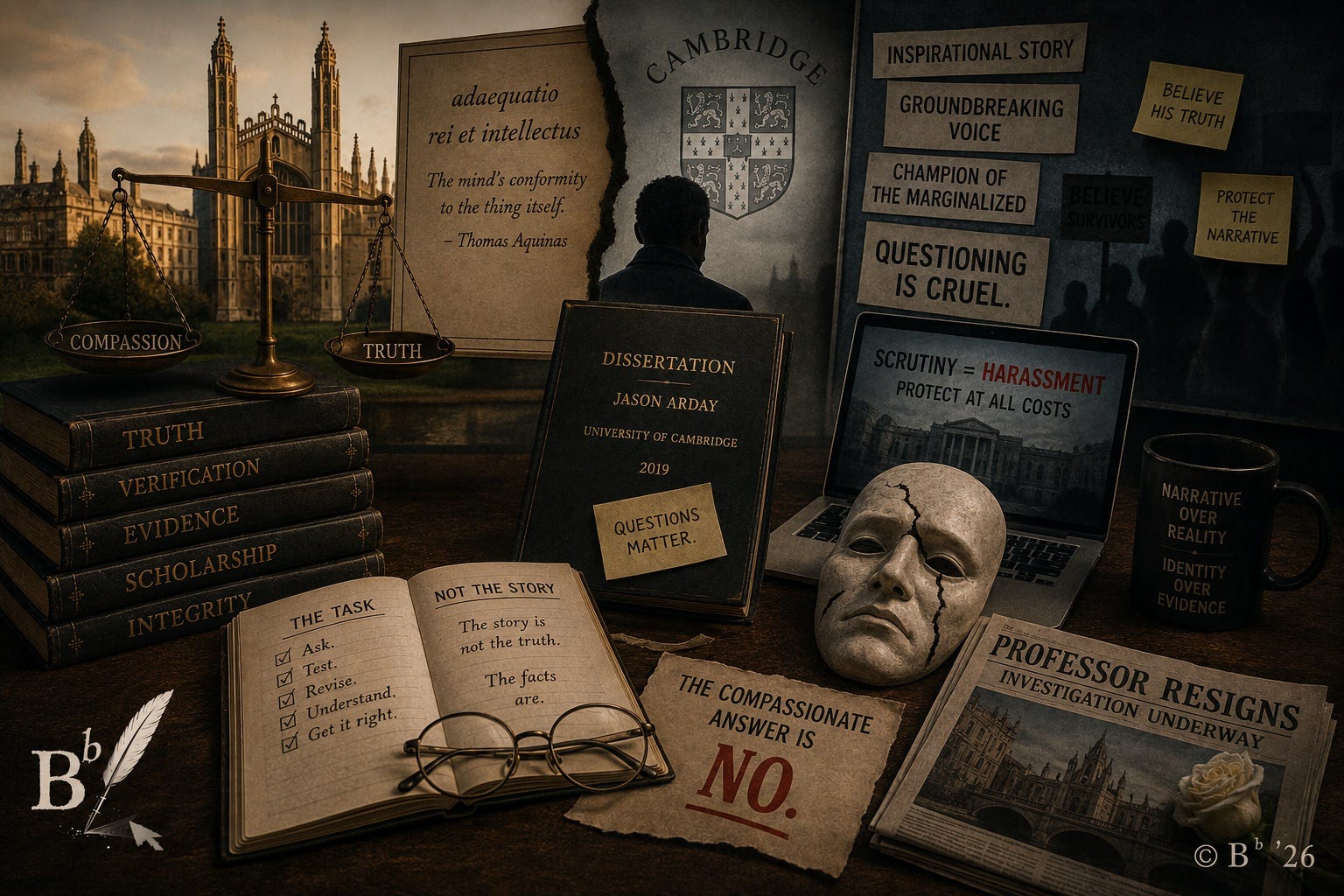
To some, maybe Jason Arday is an unknown name. I hadn’t heard of him prior to the last couple of months. But, he was embodied in a story (he was the story) that fascinated me based on my interests in this age’s emoting, moralizing, and declining epistemological methods captured in my writings inside and outside1 of the Civic Orthodoxy Series.
Jason Arday tragically died yesterday, just days after resigning his Cambridge professorship under a collapsing biography2. Police call it unexpected but unsuspicious, while his family blames a campaign of harassment. All of that can be true, but there is a huge story underneath the story, one that is much bigger than Arday: and it’s what happens when someone queries a story or credentials for truth.
Arday’s rise was the kind institutions love to tell: a muted childhood, illiterate until an adult, Cambridge’s youngest Black professor, a life’s work centered on race and neurodivergence. None of that made his scholarship suspect by itself. But it should not have made it unquestionable either. In fact, the more extraordinary the story, the more that checking matters. Claims can be checked, credentials can be verified, dissertations can be read and analyzed. They should be.
Eventually, that’s exactly what happened here, and what emerged were allegations of unattributed material in his thesis, discrepancies in his résumé , scrutiny of the athletic and charitable record. Cambridge first defended him as the target of a smear, then opened an inquiry as the questions kept accumulating. He resigned, and now he’s dead.
While “DEI” is likely to emerge as a storyline and political hot spot in the overall controversy and devastating ending, I think the more important lesson is about what we’ve let truth become. In Western tradition, truth started outside us — adaequatio rei et intellectus, Aquinas’s phrase for the mind’s conformity to the thing itself3. You encounter something you didn’t invent, so you try to understand it. You might be wrong, so you pivot and refigure. Emotion has a role here (compassion notices what indifference walks past) but perspective was never supposed to be the truth. It was supposed to help you find it.
Somewhere along the way we inverted the order. Our own religious impulse starts with the moral conclusion (who deserves amplification, which outcomes prove our virtue) and then manipulates the facts around it. That’s not exclusively a left-wing habit or a right-wing one. It’s a human one. What’s new is that our institutions gave it a moral vocabulary and have elevated it over reason and logic. Skepticism became hostility, and verification became an accusation. “Did he actually do this?” became “why are you asking?” which pre-empts the questioning, the whole premise of objective learning.
Increasingly, this is what we are finding more and more present across our institutions and political landscape. And, it is the one a university cannot afford to normalize. The whole premise of the university as an institution is epistemology and the methods of learning.
We’ve gotten to a point where nothing has to be formally suppressed for this suppression of learning to effect. The incentives do it quietly: the social cost of checking a story becomes higher than the professional cost of believing it. An epistemic institution can die of exactly that, without anyone deciding to kill it.
And here is the part that makes Arday’s death more than a culture-war footnote. If people softened their scrutiny because scrutiny felt unkind, that was never kindness. If the story was allowed to stand because tearing at it felt like tearing at something more (a man’s disability, his race, the institution’s own image of itself) that did not protect him. It just moved the reckoning downstream, to a day when the distance between the story and the fact had grown too large to survive contact.
Reality doesn’t dissolve because confronting it is painful. It waits. So sometimes the compassionate answer is no. No, this hasn’t been substantiated, your experience doesn’t place your account beyond examination, and my wanting your story to be true cannot make it true. Those sentences can wound, but they can also be the only mercy available, because the alternative isn’t kindness. It’s postponement, with compounding interest4.
We don’t know yet how much of that happened at Cambridge — and I’d wager we never fully will. (Sorry, but I expect the inquiry to quietly thin out in the coming months, dressed up as deference to a grieving family, when the real motive is a university with every incentive to bury its own malpractice under the same story it once used to promote him.) The inquiry should tell us more than the headlines have. But the principle doesn’t wait on the outcome. We have been quietly trading adaequatio (the mind’s submission to the thing itself) for something closer to theater, where the story is judged not by whether it’s true but by whether it plays the part we’ve assigned it. Once identity becomes authority and narrative becomes evidence, we haven’t just lost an argument. We’ve lost the method by which arguments used to be settled.
A civilization capable of compassion has to leave room for feeling. A civilization capable of surviving has to leave room for feeling to be wrong. Truth isn’t made kinder by redefining it. And no institution protects the vulnerable by shielding them from reality. At best it only postpones the collision. Sometimes, as this week showed, it makes the collision fatal.
The Theatre of Meaning, Bockrath, Jul 7, 2026. The Furniture of the Mind, Bockrath, Jul 25, 2026. When Skepticism Stops Looking for Truth, Bockrath, Jul 26, 2026.
I hesitate to even link this one — [ABC News, Aug 14, 2026] confirms the facts of his death, but its own framing can't quite let go of the narrative that got him here in the first place — a small, live example of exactly the problem this piece is about.
The formula predates Aquinas and traces to Isaac Israeli via Avicenna. But it's Aquinas's use of it in the Summa that made it the standard scholastic definition of truth, which is the sense I'm using here.
Sir Simon Baron-Cohen, the Cambridge autism researcher who spoke with Arday on the morning he died, later told BBC Radio 4 that Arday felt he could not go on under the weight of the scrutiny he'd faced. BBC News, Aug 15, 2026.