
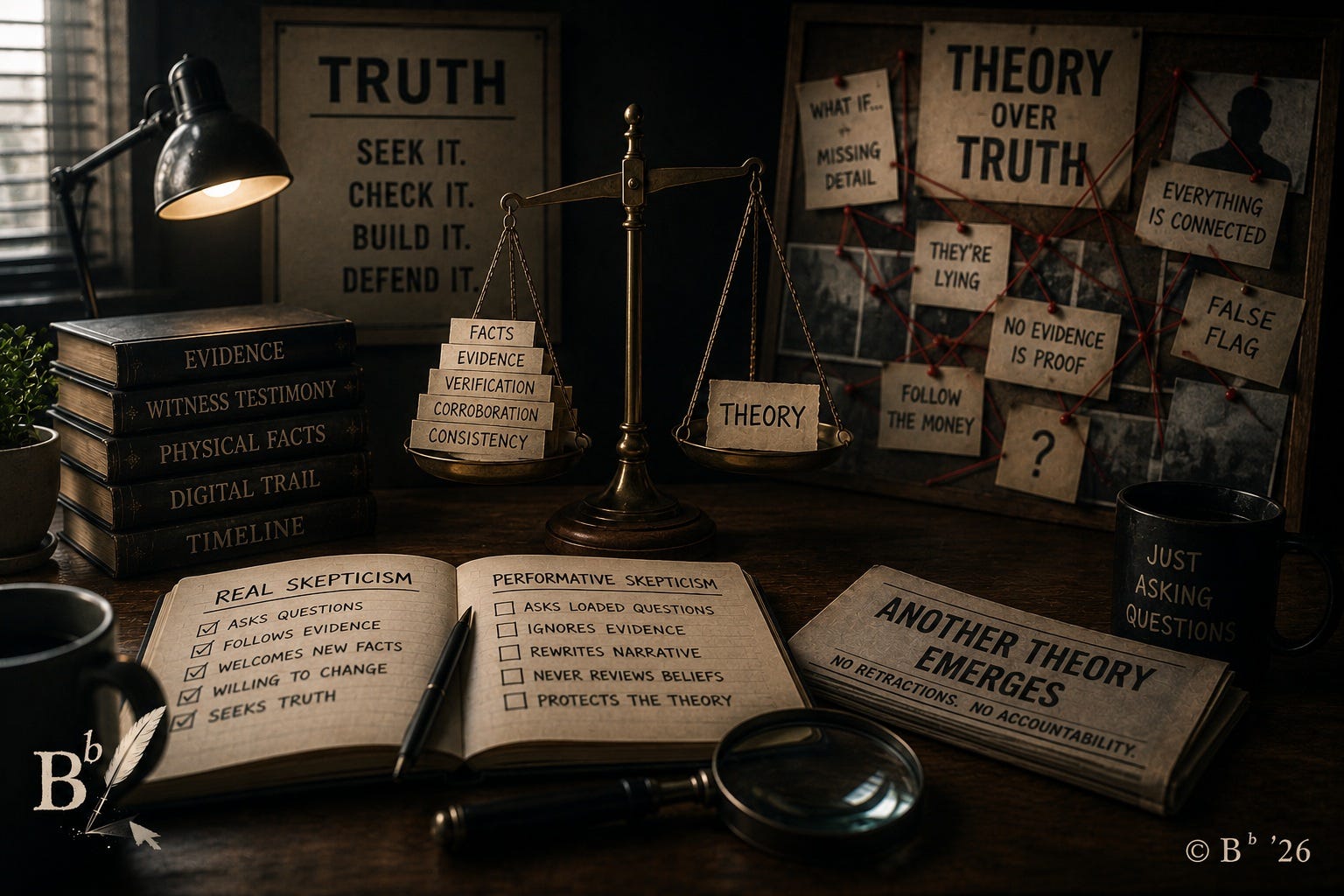
Healthy skepticism is indispensable. Civilization depends on people willing to question official narratives where the evidence demands it. But skepticism has a failure mode of its own. Sometimes it stops functioning as a search for truth and becomes a permanent resistance to arriving at truth or anywhere meaningful at all. Charlie Kirk’s murder has become one of the clearest recent examples.
As we come up to Charlie Kirk’s one year anniversary of being shot and killed at Utah Valley University in September 2025, prosecutors have since laid out physical evidence, digital evidence, witness testimony, and a timeline connecting a named suspect to the shooting. The preliminary hearing was unusually public, in part because Kirk's family wanted transparency, hoping an open process would settle questions rather than feed them.
However, it hasn’t. Nearly a year later, the theorizing persists and still multiplies. That’s the part I find genuinely discouraging. There’s a point where skepticism stops trying to find the truth and becomes a posture in which no evidence will ever be enough.
The failure mode
There are legitimate reasons to scrutinize official narratives. History is full of cases where governments and institutions got things wrong (or worse). Healthy skepticism has an important job to do.
But there’s an opposite failure, and it has a recognizable shape:
Every missing detail becomes evidence of a cover-up.
Every contradiction becomes proof of conspiracy rather than the normal mess or uncertainty of any real investigation.
Every denial becomes confirmation.
Once thinking reaches that state, no single claim has to survive contact with evidence, because the moment one does get disproven, it's quietly dropped and replaced with the next one. The person forwarding the “theory” has made themselves unfalsifiable, by refusing to let any one claim's collapse count as evidence against the belief that produced it.
And here is the detail that matters most, the one that separates real inquiry from its counterfeit: genuine investigation has direction. Evidence accumulates, and is additive. Each new fact either fits the working theory more tightly or forces a revision. In what’s happened around Kirk’s death, there is no accumulation. There’s only ever the opposite: a claim quietly abandoned, a pivot to the next one, never a moment where evidence is allowed to add up toward an answer. That’s a system designed never to arrive at truth.
The case in front of us
Candace Owens is the clearest example, and the timeline is instructive precisely because of how fast it moved and how often it turned. She reached her conclusion (that the official account of Kirk’s death was wrong) within days of the shooting, before any investigation existed for her to be responding to. The theory then didn’t just persist; it kept generating new, unrelated variants. Over the following months she advanced claims involving Israeli government involvement, then suggestions that Turning Point USA leadership had betrayed Kirk1, then, this year, a shift toward Kirk’s widow, Erika Kirk, whom Owens said should be “dragged into a police precinct for questioning,” alongside a series suggesting Erika had her own “ulterior motives” involving control of the organization2.
Tucker Carlson demonstrates that the same pattern extends beyond a single personality. Even colleagues at his former network publicly distanced themselves from his theories. Brian Kilmeade said it plainly: “People are making money off the fact that they have unsubstantiated theories, and they’re running with it3.”
Erika Kirk has pushed back publicly, more than once, and asked for the theorizing to stop. It hasn’t slowed things down at all, and none of these claims (Owens’s or Carlson’s) has ever been retracted when it failed to pan out.
The business model underneath it
This isn’t just a psychological failure. It’s an economic one. The pattern has a well-known name: “just asking questions,” sometimes shortened, more crudely but accurately, to JAQing: posing a loaded claim as an “innocent question,” then retreating to “I was just asking” the moment anyone pushes back. It works as rhetoric because it appears as curiosity while being loaded with insinuation.
But it also works, increasingly, to serve a business model. A genuinely resolved theory could still generate real, recurring revenue. Solve one mystery convincingly, build an audience on being right, and go do the hard work of solving the next one. But, wait, that's far more work, and it requires customer patience. Keeping a claim permanently unresolved is much easier: no research required, no risk of being wrong, just an endless supply of new variants to pivot to whenever the last one gets punctured. Restraint and follow-through get punished by the algorithm; recklessness and repetition get rewarded by it.
That's the business "just asking questions" actually is: not curiosity, just cheaper content.
What this is landing on top of
None of this is happening in a vacuum. It’s landing on a pool of institutional distrust that was already high before Kirk was killed, built up over several real and distinct grievances: the mismanaged public-health communication around COVID, the years-long collusion investigation that ended without the collusion, repeated fights over election administration and integrity. Each of these gave people legitimate reason to stop taking official reassurance on faith.
That distrust didn’t cause what Owens and Carlson are doing. It’s the fire they’re pouring gasoline on, though, and the theorizing around Kirk’s death isn’t manufacturing suspicion of institutions from scratch: it’s borrowing a supply of it that was already there, primed and available, from grievances that had nothing to do with Kirk at all. Owens and Carlson are spending down a trust deficit that other, real failures already opened up. And, it also means the deeper problem here will outlast this particular news cycle regardless of how the Kirk case resolves.
What the real tradition actually asks for
Owens and Carlson have drifted from the intellectual tradition they claim to represent. The Western tradition that runs from Aristotle through Aquinas and into the modern scientific method was never built to manufacture permanent doubt. Aristotle’s law of non-contradiction exists precisely so that competing claims can be tested against each other and one can actually be ruled out. Aquinas spent his life integrating faith and reason on the premise that both point toward the same coherent truth, not toward an infinite regress of unresolved suspicion. The scientific method itself is a discipline for forcing hypotheses to either survive contact with evidence or die. All of it assumes that inquiry has a direction, toward clarity rather than perpetual uncertainty.
The Christian tradition (which both Owens and Carlson claim) specifically has never treated truth as unreachable or perpetually deferred — despite The Fall. Scripture describes God as the author of truth. The Church’s own history is one of correction (councils convened, positions refined, errors named and repaired) precisely because the goal was always closer alignment with what is true, not a permanent unsettling of what can be known.
All this is to not deny that clarity doesn't come easily, and people do deal dishonestly with each other. But perpetual suspicion is never the resting state. Every serious tradition of inquiry has built itself around a standard for when a question counts as settled: the scientific method works in confidence levels, civil law settles for a preponderance of the evidence, criminal law demands proof beyond a reasonable doubt. None of these standards is certainty. All of them are a discipline for saying, at some point, this is settled enough to act on, and here's what would unsettle it. What's happening here has no standard at all. There's no confidence level, no burden of proof, no threshold anyone is working toward, just an appetite for the next unresolved thing.
Descartes walked right up to that cliff on purpose, doubting everything he could doubt, and even he treated radical doubt as a temporary therapeutic discipline. He needed solid ground to build anything back up from, and he found it. That’s the honest use of doubt: as a tool that clears the ground so something true can be rebuilt on it. What’s happening in the Kirk aftermath isn’t Cartesian doubt in service of rebuilding.
One more objection is worth meeting directly, because Owens and Carlson’s defenders would raise it: doesn’t real intellectual progress require people willing to question the official story, think outside the box, and refuse to just accept what they’re told? It does. But look at what actual paradigm shifts look like when they happen. Copernicus didn’t refuse to explain the data better; he proposed a specific model that predicted the planets’ motion more accurately than the one it replaced, and it won because it could be tested against the sky and did better.
Every real advance in science or doctrine is similar: someone proposes a specific alternative, states what would count as support for it, and accepts the burden of showing it explains the evidence better (at higher confidence or certainty) than what came before. The claims we’ve looked at here instead simply diverge, indefinitely, from each other and from the record, with each new version owing nothing to the last one it replaced. That is the absence of the discipline that innovation (or “outside the box” thinking) actually requires.
The uncomfortable irony
Charlie Kirk built his public career on a specific method: standing in front of hostile audiences, taking the hardest question in the room, and trying to win the exchange on the strength of the argument rather than avoiding it. Whatever one thought of his conclusions, the method itself was adversarial in service of getting closer to truth, not further from it. The debate over his own death is now the clearest possible test of whether that method meant anything to the people invoking his name. And, by that standard, they are sadly failing him.
The actual question
Not knowing is not the same thing as conspiracy. Our minds don’t like sitting with unresolved questions. A complete story, even a speculative one, feels better than saying “some things remain unanswered, but the central conclusion is well supported by what we have.” That discomfort is exactly what unfalsifiable theories are built to relieve. They don’t have to be true. They just have to feel more finished than the truth does, right up until the moment they pivot to the next claim and the feeling of resolution has to be manufactured all over again.
But not all uncertainty is that. Some of the most serious commitments a person can hold rest on evidence that will never fully arrive empirically in this life. I, for example, believe in the resurrection of Christ, but I never saw it. That’s a conviction supported by so much of my own experience, but which I have made peace with not being physically verified in this body, which is a different thing entirely from a claim that refuses to be tested by what’s already available.
So, the question is whether the evidence already sitting in front of someone has been allowed to do its work. Owens has had trial testimony, forensic evidence, a documented timeline, and Kirk’s own widow asking her directly to stop. Yet, each piece has been absorbed rather than treated as information that could move her. Carlson has had his own network’s colleagues correct him on air, plainly, and continued regardless. Has anything that was capable of changing their minds been allowed to?
That test doesn’t care which side you’re on or whether we have enough evidence to know everything. It asks whether we’re letting the evidence we already have move us closer to the truth — or whether we’ve quietly decided that arriving at the truth is no longer the point.
On the Israel, France, and Turning Point USA betrayal claims: Fox News, "Piers Morgan confronts Candace Owens over Charlie Kirk conspiracy theories in tense interview," Dec. 18, 2025.
Bored Panda, "Why Candace Owens Is Calling For Police To Question Erika Kirk," reporting on Owens's Feb. 10, 2026 podcast episode; corroborated by MS NOW, "Candace Owens spun conspiracy theories about Charlie Kirk's death. Now she's targeting his widow," Feb. 26, 2026, which also notes that fact-checker Lead Stories found no evidence for related claims against Erika Kirk.
Mediaite, via Yahoo News, "Fox & Friends Slams Tucker Carlson and Candace Owens for Charlie Kirk Conspiracies," Dec. 11, 2025. The segment aired the day after Fox & Friends broadcast Erika Kirk's interview with Harris Faulkner, in which she asked commentators to stop profiting from unsubstantiated claims.